Theresa Nichols Schuster, Author of "Brittle Silver" and "We Are the Warriors" Finalist in the 2015 USA Regional Excellence Book Awards, Young Adult Fiction, West region. WE ARE ALL ON A JOURNEY - UNIQUE, EVERCHANGING, SURELY REMARKABLE **** To view complete webpage on mobile devices, click on "View Web Version" at bottom of page.
Contact information
Comment sections available at the end of each blog.
For additional information contact Theresa Nichols Schuster at tnschuster7@gmail.com.
About Theresa Nichols Schuster
- Theresa Nichols Schuster
- Theresa Nichols Schuster is author of "Brittle Silver" and "We Are the Warriors" a 2015 USA Regional Excellence Book Award Finalist. She currently lives in southwest Montana where she appreciates the wonders of nature, family, friends, a bit of pottery.
Friday, March 27, 2015
Goodreads Giveaway and Award
Congratulations to the winners of my Goodreads Giveaway that wrapped up on March 25th! The total number of people entering the giveaway was 829. Five people won copies of "We Are the Warriors." Of these five, three were from Canada and two were from the United States (Florida and New York). Thank you to all who entered the Giveaway.
The day after I mailed out my novel to the winners, I was notified that I had been selected as a Finalist for the USA Regional Excellence Book Awards for the Young Adult Fiction category, West region. I was so excited to hear the news! I knew the USA REBA awards would be announced in mid-March and was waiting to hear, without "expecting" too much.
The announcement stated "Your book, We Are the Warriors, truly captured the spirit of the West region of the United States and the excellence that this award was created to celebrate, and we salute you and your fine work."
Only one Winner is named for each category of the USA REBA awards. Finalists are not necessarily awarded for each category. So many categories did not have Finalists awarded. Judges also reserved the right to not make an award in a category.
The REBA awards sites states, "often there is more than one book in a category that truly stands out, and we believe these deserve recognition also. While it makes the job of our judges harder in some ways, we are dedicated to celebrating excellence in self-published books. So we created the category of "Finalist." Books that are recognized as Finalists are in every way outstanding. The difference between the Winner and Finalist books are often so minute that the call might have gone either way."
The West region that my novel was named a Finalist for includes the states of California, Alaska, Colorado, Hawaii, Idaho, Montana, Nevada, Utah, Oregon, Washington and Wyoming.
After all the years of work and taking the leap of indie publishing, the recognition is muchly appreciated.
Wishing you in the northern hemisphere a wonderful start to spring and ALL a good Easter week.
Sunday, February 1, 2015
Blizzards and Editing
I have found both format editing and blizzards painful while
in their midst, but each also results in wonderful connections and beautiful
art.
The last true
blizzard I was in, I was fortunate to be near our house in Wolf Point. As I
drove the short mile from work with my husband, Jerry, only fifty yards behind
me in the Acadia, the cross streets disappeared as sheets of snow beat in waves
from the northwest. A white and gray pall covered the landscape and sky,
obscuring any distinct shapes and forms. I diligently plowed my way up the 4th
Avenue hill.
I feared I wouldn't recognize the way home. A similar
fear and trepidation sometimes comes over me when I sit down to edit a long
literary piece. I don't know my way through the mass of words and punctuation. I
fear making a mistake and causing more problems and errors.
In a state of confusion that day, I gripped the steering
wheel, and peered out into the haze. The outline of the towering cottonwoods at
the corner of our turn finally broke through the dense whiteness, their bare
branches rattling in the wind like angry giants.
My Impala bravely bucked through the drifts forming
across the city streets. I stared out the windshield, and nervously hoped no
one was hidden in the blinding snow. My foot on the gas pedal, I dared not slow
down, knowing one of those drifts would grab my wheels and not let me out.
In the process of editing, when I hit "find"
and "replace" in a document, especially when it has resulted in 1,000
cases "found," a tremor of dread runs through me before I hit
replace. What if I make it worse and get
stuck? What if I ruin the whole novel?
That afternoon as I approached an unsheltered curve in
the road, less than a half of a block from our house, the shadowy form of a
van, obviously tightly stuck in a drift, came into view. I let up on the gas
and steered to the side to avoid hitting the vehicle. First mistake. With a
sudden "fump!" my car came to a halt. The right side of the car sat
higher on the wind-packed drift, as my wheels spun.
My husband stopped a hundred yards behind, got out and fought
his way to my car. As I opened the door, a rush of snow blew in, covering the
floorboards in a fine layer. He suggested I back his Acadia up to the next side
road to open up the center of the street while he tried to get my car unstuck.
I clambered into his vehicle and backed into the side road, firmly hitting
another two foot drift. Second mistake—beware of side roads. I tried to go
forward or backward, to no avail. Now the Acadia was unable to move.
Sometimes I do get stuck and bogged down when I am
editing. The time I fought with fixing my "smart" quote marks and
"straight" quote marks, I couldn't figure my way out. I finally got
it done, probably not the easiest way.
Jerry and I trudged to our house, only seventy-five yards
in distance. The wind chill was an unbelievable fifty degrees below zero or
more. We changed from our office clothes into jeans and down parkas, gathered
more shovels, and headed back into the onslaught.
Frantically we pulled shovel-fulls of snow from under the
car. Each time we pulled out a chunk of snow, new snow replaced what we had
just removed. Every time we opened the car door to attempt to rock the car
free, the white powder filled the compartment like piles of flour. Whenever we
opened our mouths to speak, the wind-driven snow blasted our throats like pieces
of sand and knocked our breath back down our throats, resulting in gasps of air.
The snow melted on our faces and then refroze wherever it could. My eyelashes
were thickly caked, heavy with ice that threatened to freeze my eyes shut. The
whole endeavor seemed hopeless. I felt like we should just quit, but we couldn't
leave our vehicle blocking the road.
Through the blinding snow, a huge four-wheel drive
pick-up from the Fort Peck Tribal Police crawled its way toward us. A big,
burly tribal cop climbed out, snow nearly up to his hips. He grabbed one of the
shovels and got to work on the dense drifts under my car. A tribal high school
student clambered out of the truck, wearing what looked like a spring jacket.
They both shoveled, pushed and pulled alongside of us. It seemed like an
impossible task, but the guys never quit, never expressed any doubt or dismay.
Finally, with one more big effort of all hands pushing, my car broke free. Relieved,
I promptly drove it into my driveway and parked it.
Then we went to work on the van and our Acadia. By then
glasses were useless, only reservoirs for ice and snow. Hands worked clumsily,
the painful cold beginning to numb. With tireless effort, the cop, his young
friend and other neighbors chipped in to fight against the relentless wind and
snow.
There is nothing like friends, books, experts,
co-travelers posting up on Google, to assist with the process of learning to
edit more skillfully, I have had very good input, knowledge and suggestions
over the years. I marvel at how little I knew about writing—that is, the whole
process—seven years ago! Eventually with much effort and help, I/you will make our way
through an edit, a process, a piece of art or a new woodworking project.
Finally, our vehicle and the van broke free. Trudging up
the driveway late that day, exhausted, frigidly cold, I spiked our shovel into
the snow bank at the corner of our house, an offering for the next stuck
vehicle. Jerry, by then nearly hypothermic and shaking uncontrollably, fell
into a hot tub of water.
How many people and cars that policeman and his friend
freed from drifts that day, I don't know. But I admired their courage,
tenacity, and willingness to take on such a daunting task—cheerfully and
optimistically.
The results that day—freed vehicles, grateful people safe
at home—and eventually, artfully created drifts, and moisture for the land to irrigate
and grow summer crops and pastures.
Format editing long documents like a novel or a thesis
can feel a bit like facing the relentless onslaught of a blizzard. But bit by
bit, sentence by sentence, with persistence and some help, a structurally sound
and beautiful document can be created.
Happy editing, formatting and digging out of snow drifts
if that is what is needed. The outcome may be awesome. Spring will come.
Thursday, December 11, 2014
Pain and Prejudice
We Are the
Warriors, a novel set on a
fictitious Indian reservation, is almost ready to go public. My editors and proof
readers have provided insights and suggestions, the cover is almost completed,
and Blake's story about life in Powder River is about to unfold, first as an
ebook the end of December, and in paperback after the first of the year.
We Are the Warriors’
main character, Blake, is a seventeen year-old—a white kid and avid
snowboarder— who is thrust into the middle of a plains Indian reservation.
Blake's story is a story of his fears, his search for friendship, and his gradual
understanding of those different from himself. It is a journey through his own experiences
and changing perspectives.
Living for thirty years on the Fort Peck Assiniboine and
Sioux Reservation, the images and persona of "warrior" for me have been
multifaceted. One of my early introductions to the cultural life of Wolf Point
was attending the Wild Horse Stampede, a rodeo well respected by the cowboys
and cowgirls across the West.
My first trip to the Stampede, sitting in packed stands
as the blue smoke-haze rolled by and beer amply flowed, I encountered an event that
surprised and shocked me. It began with an auctioneer leading the bidding, the
Calcutta, for the wild horse teams while standing in the back of a pick-up in
the dirt arena. As the auctioneer's voice spun by, like a train on a track, the
bids went up by hundreds of dollars, some even reaching over a thousand. The
Jackson name brought the bids in higher and higher. Later I learned the Jackson
"boys," men from the small tribal town of Frazer down the road, were
highly respected for their ability as wild horse racers.
The Wild Horse Race that occurred after the next event
was the most insane, wildly dangerous event I had ever witnessed. About eight
unbroken broncs were pinned in chutes, while three men, on the inside of the
arena, stood in front of each horse. Two men grasped a lead rope attached to
the bronc, typically very large and strong guys, and the third held a loose
saddle, usually a smaller, light-weight man.
At a signal, all eight horses are released into the arena
as the gates fly open and twenty-four men attempt to subdue the wild blood and
muscle before them. Hooves fly everywhere, men are tossed in the air, horses
run into one another. It is not a matter of if someone will get hurt, just how
badly. Some teams manage to get a saddle on their horse. The rider, clinging on
however he is able, attempts to ride the horse to the other side of the arena.
By now, half the horses have broken away from their
supposed masters and run wildly around the arena, their ropes dragging behind
them. The few horses that are saddled up with a rider, buck or run randomly. If
a rider is lucky or skilled enough to get to the other side, past the white
chalk circle, he pops off the cinch on the saddle midstride, flies through the
air, hoping to land without damage, then hauls the saddle back to the chutes.
The pandemonium in the middle of this race is hard to
describe. The sheer magnitude of possible injury unbelievable. It reminds me of
the Running of the Bulls, but ten times more unpredictable. I was shocked by
the crowd's enthusiasm and enjoyment of the event—like those waiting for a
NASCAR crash or watching those high-risk-taking videos. Many of the teams were
tribal, although not all. The most skilled and admired apparently were the
tribal teams. Rodeo is a dangerous enough event. Cowboys take on one horse, one
bull at a time and usually can see what is coming at them. This was by far more
hazardous.
As the years went by, I would at times walk out to the
concession stands during the Wild Horse Race to protest what I saw as a
macabre, violent fascination. I did not want to be part of seeing others beat
up, hurt and possibly killed. At other times I would sit there with the rest of
the crowd, relieved when it was over. One year a young tribal man, saddled up,
sliding sideways off a horse galloping around the arena at about thirty miles
an hour approached, from the opposite direction, a pack of wild horses, running
equally fast, their ropes dragging on the ground. The man, hanging sideways,
his head at the level of the horse's chest, met the chest of one of the horses
charging the opposite direction. Not good.
I'm not sure how long he was in regional medical centers
dealing with his head injury. A couple of years later I crowded into a spot in
the stands as the Calcutta for the teams began. Huh, what? His name was read as
a member of one of the wild horse teams! I don't get it. He's going out there
again!
Later, that next summer my husband and I went to the Red
Bottom Pow-wow. We wandered towards one of the benches, hoping to blend in. Fat
chance. But we did see a few familiar faces.
A young man, dressed for the grand entry, came up to us
and welcomed us to the pow-wow. He reminded us of who he was, a fellow student
of our older son, now in his thirties. As he spoke I began to recognize the
face and build from years ago. I could again picture him as the athletic, point
guard he was years ago for the Wolf Point High basketball team. As he walked
away, feathers swishing and metal jingling, I felt happily surprised to be so
welcomed by the young man.
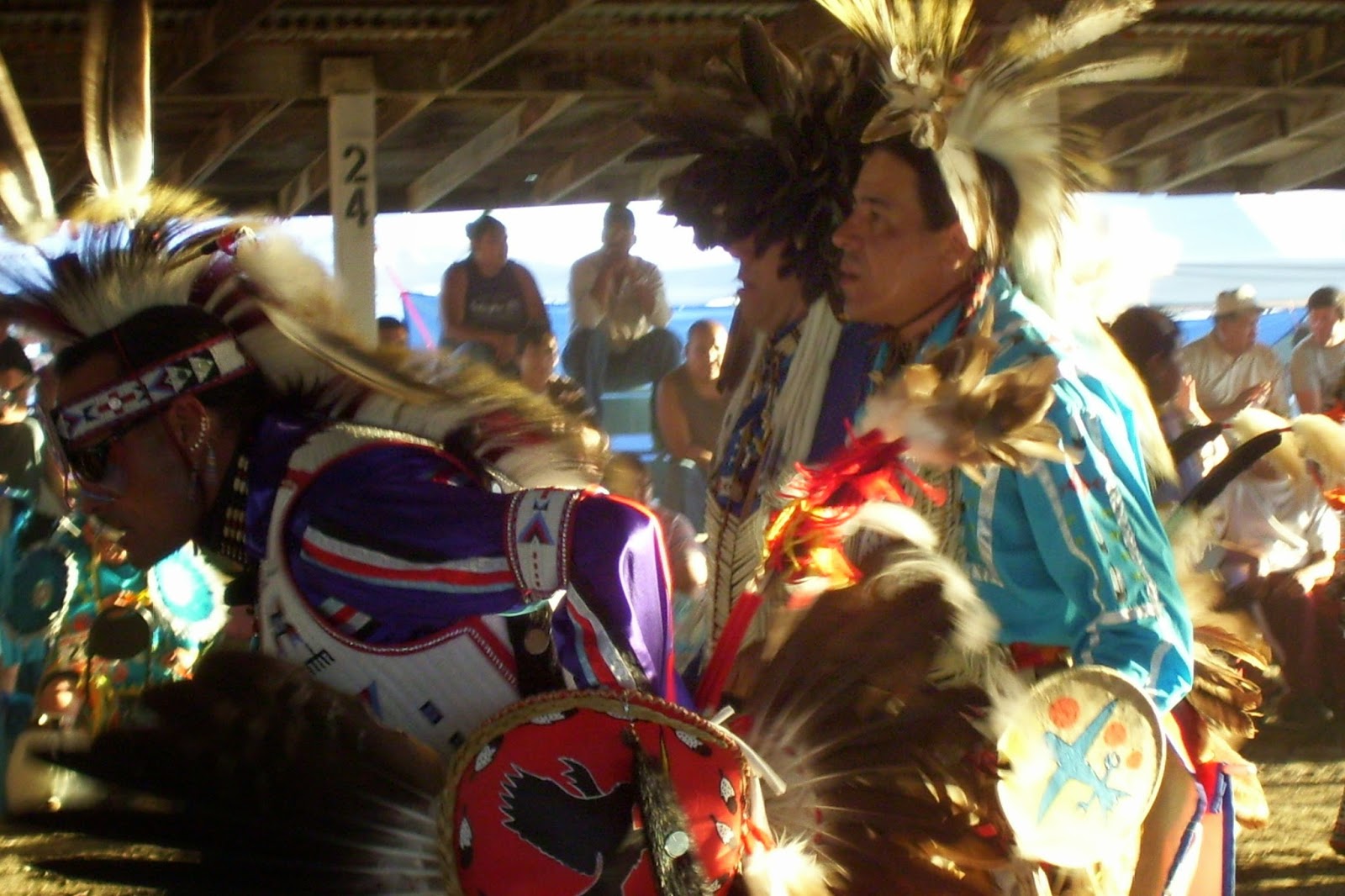
As the grand entry got underway, the tribal members with
military service were asked to lead the entry. The drums and voices surrounding
them in respect. The warrior as always, is highly regarded in tribal circles.
Next, to my amazement, the caller announced the honoring of the wild horse racers,
with their entrance into the arena. These men, who tackled horses in a wild,
free-for-all, are highly regarded by the Assiniboine Red Bottom Clan. I
couldn't believe it. My mind had to make a cultural U-turn to see the Wild
Horse Race from another viewpoint, one foreign to me. Obviously there was
something powerful being said here. The ancient, and yet still current role of
warrior emerged as vital to tribal life. I still ponder and process this
perspective, one that challenges my way of seeing, of admiring participants of
a wild, dangerous, even deathly event.
I still cringe when I hear that one of my son's
classmates has chosen to be on a wild horse team for the Stampede and will to
participate in this unpredictable, uncontrolled and dangerous event. I wonder
how his parents or family members feel about it. I pray they stay safe.
My novel, We Are
the Warriors is fiction. The amazing thing about fiction is that it can often
tell an even more powerful story than true life, because with fiction there are
no specific apologies needed and no permissions required to share the whole
story. A fictional account speaks for itself and its characters have a life of
their own.
Even before I moved to Wolf Point I had often reflected
on my family ties to Native Americans. I knew my dad had graduated from St.
Labre Indian School. I grew up visiting my grandmother in Lodge Grass on the
Crow Reservation. I was also aware there were some family members with darker
skin and hair. I wondered if I had American Indian ancestry. For years I
searched, asked questions of older family members, checked family lines, but never
did find a connection to American Indian ancestry. Even as a young kid I knew
that "white folk" would hide that kind of information—and I knew that
was wrong.
Will I ever see life exactly as a Native American, First
Nations or indigenous person who grew up and lived on an Indian reservation?
No, I can't. But I can listen to my stories and the stories of those around me.
I can process and see as one of European ancestry, white and female, who grew
up on the banks of the Yellowstone River and lived for most of her adult life on a
reservation—a place of unique experiences, a place of complexities and conundrums.
My experiences on "the rez," those of the warmth of family care and
concern, the shock and tears of sudden death, the gut-wrenching results of teenage
decisions, and the comradery of working together for common goals, are all a
part of me.
I present Blake's story as one individual's story, from
his limited and changing perspective. We all have a story to tell—uniquely
ours, unrepeatable, worth telling and ever changing.
Wednesday, November 19, 2014
Almost Over the Edge
Am I being dragged, sucked and propelled toward the edge of
a thundering waterfall? This past April, after years of writers' conferences,
meetings with agents, query letters, and buying, begging or borrowing writing
books from which to study, reflect on, and hone my skills, I decided to
self-publish. To go from the excitement of having a literary agent ask for my
manuscript, then making major changes, to never hearing from them again, was probably
the proverbial "last straw" or possibly "the last entire
log"...(Yes, I did use a clique′.)
As far as my writing goes, you know how it is—one day I feel
like my writing is magnificent, the next day I feel the same writing is a pile
of shit. My son once aptly told me, "Some people will like your book and
others won't. You can't appeal to everyone."
With some kindly recommendations, I found a professional
editor this spring. Honestly, I didn't expect to work so hard after years of
editing my young adult novel...His eye for detail was astounding! I received my
second edit this past month. Now onward with the self-publishing journey.
No matter how high the bar feels like it has gone, it still
goes higher. Reformatting my novel for Smashwords so it can also be distributed
to Barnes and Noble, Apple and Sony has been a challenge. Next task is
reformatting for Kindle. I think my brain is going to split with analyzing it
all.
Of course, I am required to have a cover for my ebook or
novel before publishing through most outlets. Thankfully, I have found expert help
to design my cover.
Turning my novel into a tangible paperback is another
hurdle. I'm slowly working my way that direction. It is all a bit intimidating.
I want to do it well, as good as possible. There is so much to keep track of as
I work toward self-publishing, a steep learning curve.
This all said, I haven't even begun to touch the awesome
task of marketing in our age of technology and social media. Meanwhile, I hope
there are still young people who enjoy reading.
The question I ask as I rush headlong is, "Will I
become one with the water as it sparkles, glitters and bounces playfully over
the precipice, each tiny droplet set free? Or will the encounter be something
else? Not nearly so pleasant, but still an adventure?
Wednesday, October 22, 2014
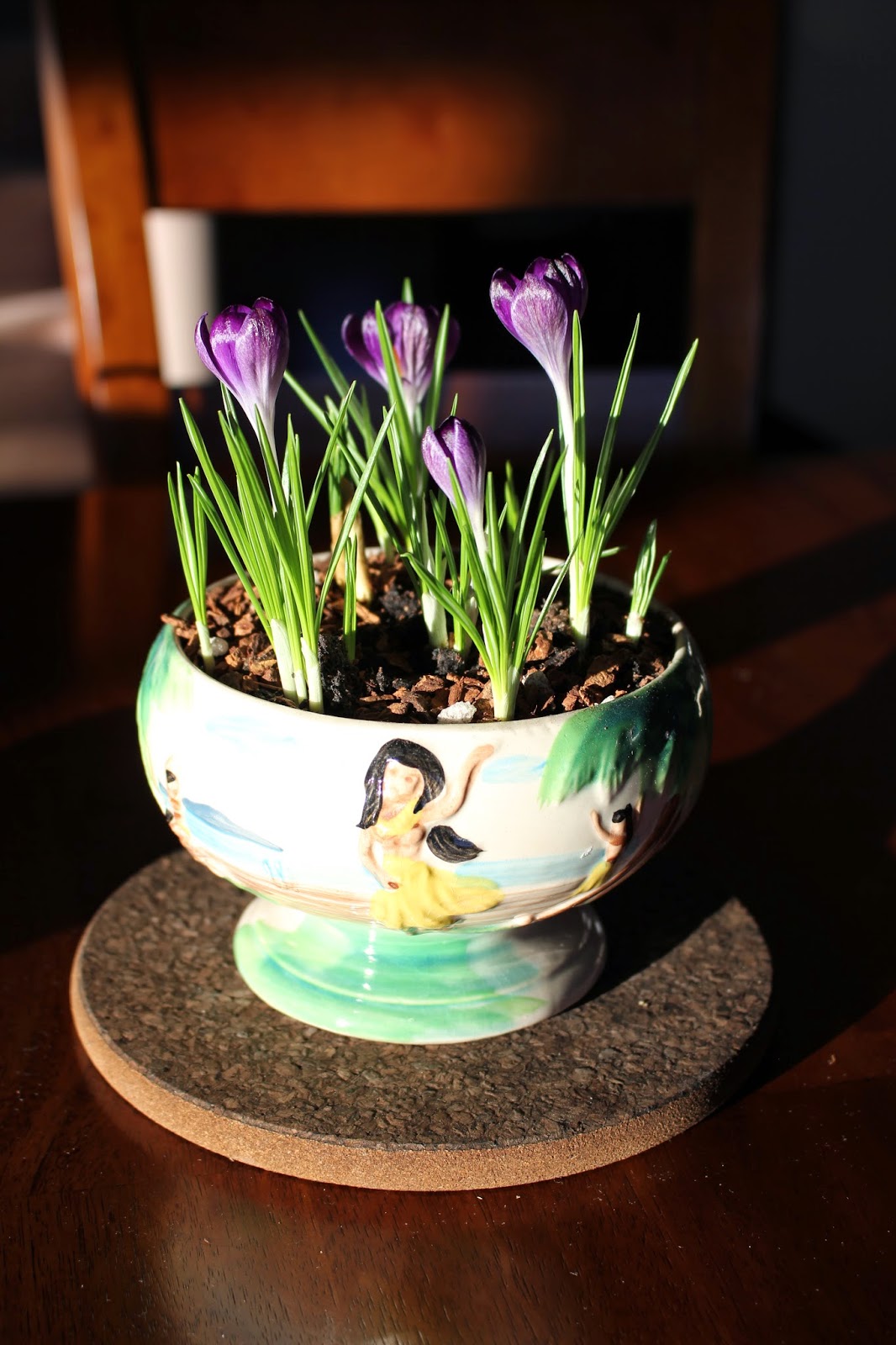
Bright Blooms in Winter
The
time has arrived. Pot up your bulbs and enjoy the beauty of indoor flowers
during the frigid months of January and February.
All
you need is a bit of garage space that goes down to at least 40 degrees for
several months, a few old pots, potting soil, and some early season spring
bulbs, and you are good to go.
Following
is a step-by-step introduction to growing or "forcing" your own bulbs
to bloom in the winter. It is a delightfully fun and mystifying project.
1.
Select some early-season
"hardy" bulbs such as crocus, tulip, narcissus (daffodil) or
hyacinth. Early-season instead of mid-season or late-season bulbs have a better
chance of blooming with the forcing method. Hyacinths are beautiful, but for
me, the long bloom time seemed to put a lot of perfume and pollen into the
house. So now I usually plant crocuses, tulips and daffodils.
2. Old interesting pots discovered in the shed,
at garage sales or at second hand stores can add a spark to your planting. It
helps if the pots have drainage holes, but if you find some you like without
holes, just add gravel to the bottom or be very careful not to over water. I
also use a lot of the old thin plastic pots that bedding plants come in and
then when I am ready to bring the bulbs in the house, I slip them into a nicer
looking flower pot. You can use small pots, except for the daffodils bulbs
which are usually quite large and will need more space and depth.
3. Select some potting soil. If you can find
some heat-treated soil it minimizes the chance of having knats or other insects
hatch out from the soil when it is brought into the warm house. Unfortunately
most name-brand potting soil is not heat-treated. Some greenhouses carry shredded
coconut potting soil which is finer, has fewer large sticks and usually has
less insect problems.
4. If you can find a few old large plastic
buckets or bins these are helpful to put the potted bulbs in while they are
chilling in the garage. The bins keep rodents away from the bulbs and the few
times you water the bulbs they will keep water from running over your garage
floor.
5. Now to get started potting up the bulbs...I
usually try to find a warm fall day I can work outside in the driveway and not
worry about the mess. Sometimes I settle for a cool day. Don't worry about the
directions for depth and spacing of the bulbs. When you force bulbs, you get to
break all the rules. Usually forced bulbs are only good for one season, but
sometimes I've dumped the old bulbs in garden spaces and they have bloomed in a
year or two.
6. Fill your pots half full of damp potting soil.
Arrange your bulbs, tips up. Crocuses will end up one inch below the soil
height, and tulips, daffodils and hyacinths tips will barely be under the soil
or only slightly sticking up. I usually place the same type of bulbs in one pot
due to the varieties of bloom times, but sometimes it is fun to mix them up and
see what happens. Fill in damp soil nearly to the top of the pots, leaving a
half inch below the rim to hold the water when you need to dampen the soil. If
the soil isn't too wet, you may water the bulbs in. Just be careful not to over
water, especially if you use pots without drainage holes.
7. Stack the pots in your large plastic buckets
or bins, cover them with newspaper and place in a cool, dark place. I usually
put mine in the garage. If you are in very cold northern climates, place them
against the interior, back wall of the garage to minimize extreme freezing.
8.
Now you wait—creatively, doing other fun things, of course. Forcing bulbs works
best with a dark, cold period where the temperature is at least as cold as
35-48 degrees. My bulbs have often been in unheated garages when the outside
temperature was often 25 below zero or colder. They did fine. This dark, cold
period is usually followed by a shorter cool, light period of optimally 55
degrees. At one time I had an unheated room in our house that was perfect for
the cool period. But now I just place the pots in the coolest place in the
house, out of direct sunlight for the few weeks of cool temps.
9. Recommended cold periods are 10-12 weeks for
crocuses, and 12-15 weeks for most other bulbs. Cool, light periods are 2-4
weeks to encourage gradual root growth and blooming. So if I plant in October,
I can bring the pots into the house in January. I usually bring in several pots
every couple of weeks to extend the bloom time for a couple of months. If you
stack your pots in the garage you may have to keep an eye on them as temperatures
warm so they don't sprout crooked under the weight of the other pots.
10. Water your pots only lightly in the winter.
Most winters I only water the bulbs twice. You only want them damp, not soaking
wet. Drier is better.
Then
enjoy—flowers in January and February—what fun!
For
more information see Forcing, etc. by
Katherine Whiteside, Workman Publishing, New York or your favorite gardening
website.
Wednesday, August 27, 2014
To Leap or Not to Leap - aka - Comma Confusion
That
tenuous perch we cling to—Should we go forward?—Shall we act?—Or should we stay
put and not take the leap into the unknown?
The
questions at times leave no clear answer. Is it time to quit that unsatisfying
job? Is it time to go back to school? Is now the time to communicate difficult
feelings?
We
lean over a precipice not knowing what result our future actions may bring.
What chain reaction, ripple effect or consequences will happen from our
choices?
We
realize that we don't totally understand our situation, other people, or the
challenges a new environment may evoke. How
can we decide with such imperfect information?
We
do have an option to do nothing new or different—that is also a choice—to let things remain the same. In
some circumstances that is not always bad. Time itself is a great changer. It has
a way of altering either the situation or how we see it.
As
I worked my way through the last edit of my novel, I was faced with questions
of what to change or leave the same. Would modifications to my phrasing,
changes in plot or cuts in content, make the story better or bog it down?
A
seemingly simple but continually confusing issue while editing was whether to
add or remove commas. Not a huge problem compared to life questions, but
vexing for a writer. Commas are, as Jim Whiting, children's
book author and editor, says, "Probably the most difficult form of
punctuation to use correctly."
The
rules of when to use commas are many and often free-flowing. Where one inserts
a pause or a comma can change the meaning of a sentence. Such as, "My
husband, said the cop, was in big trouble." versus, "My husband said
the cop was in big trouble." Big Difference!—Although not nearly as
entertaining as some of the autocorrect texts that we send each other! (Who was
it last week who texted me that she was "looking forward to getting back
out in the yard and making 'thongs' pretty?" I'm sure she meant
"things," but I haven't laughed so hard in a long time.)
It
is interesting to note that depending on where we "pause" in our
lives, where we stay or move forward, can change who we become and many of our
circumstances.
It
turns out some comma "rules" are not clear and are open to
interpretation. Like whether to put a comma before an "and" or not.
Too many commas or commas placed in simple, short sentences can interrupt the reading
and not give the reader credit for understanding the flow of the story and
plot.
A
great resource for punctuation, including comma punctuation, can be found
on-line at http://grammar.ccc.commnet.edu/grammar/commas.htm. The oft'
remembered quote of Oscar Wilde, "I have spent most of the day putting in
a comma and the rest of the day taking it out." is mentioned in the
article. I too go around in circles about the need or not for a comma.
To
pause or to leap forward? To give the reader more cues or to assume their
intelligence or ability to interpret well?
Is
that not our life challenge? To give it a break or to advance? A bit of
"comma confusion" is normal. For we never totally know the mind of
our reader nor the personalities and inner workings of our friends, family,
co-workers and acquaintances.
Sometimes
we ride on the flow of the waves, not questioning much, just letting ourselves
be one with the movement. Other times a decision is called for, or an action
required. How will we punctuate our lives? Where will we linger? Will we be understood
or appreciated? Will we decide to leap—accepting our inability to fully know
the consequences of our choices?
Thursday, June 19, 2014
Seven Years!?
It
is with a bit of trepidation I have begun another edit of my young adult novel,
We are the Warriors. This time I have
the unique advantage of working with a professional editor. My family and
friends had assisted often enough, until I think I wore them out. Their
assistance over the past seven years of my novel has been very valuable. It was
time to get some additional, experienced advice.
So
I have my first copy from my editor in hand...Suggestions to cut 9,000 words,
reflections on lapses of time or skips in relationship development, corrections
as to terminology...all very good.
The
challenge is to get creative again about a text I really want to be done with.
Seven
years. I keep saying seven, I've worked on this novel, but I'm afraid to go
back and count, it may be more...
Three
writers conferences, three meetings with literary agents, suggestions to
improve, query letters sent out to agents, finally a request for my manuscript
from a literary agent at a conference. That was an exciting day! Later, the
email back, suggesting changes to improve the novel, and a request to resubmit
if I make substantial changes.
Between
moving and closing offices for a year, I finally had a new version. I cut
characters, dropped scenes, added more dramatic tension, sent it off to the
literary agency. No response. No response. Ask for an acknowledgement. No
response. Has the publishing industry changed so much that it no longer has
basic courtesy when it has an author's manuscript?
So
now the question remains, as we work toward a fresh polished copy, whether to
continue 'cold' query letters to agents or to self-publish in some fashion.
Whatever happens, I intend to have the best novel that I feel I am capable of
at that time...and one that is actually finished!
Subscribe to:
Posts (Atom)