Contact information

Comment sections available at the end of each blog.
For additional information contact Theresa Nichols Schuster at tnschuster7@gmail.com.

About Theresa Nichols Schuster

My photo
Theresa Nichols Schuster is author of "Brittle Silver" and "We Are the Warriors" a 2015 USA Regional Excellence Book Award Finalist. She currently lives in southwest Montana where she appreciates the wonders of nature, family, friends, a bit of pottery.

Saturday, May 30, 2015

Goodreads Giveaway, A Powerful Read and New Website


I was excited to get a message from Jakarta, Indonesia from one of the winners of my novel, "We Are the Warriors," that my book had arrived fine. Neat to hear! In a Goodreads Giveaway the end of May, five individuals won copies of my novel, that included the REBA Award Finalist notification. The winners were from New Hampshire, Illinois, Ontario, Florida and South Carolina.

You can now find me at www.tnschuster.com! This web address will also link up to my blog. It is a work in progress...I finally took the leap!

On my way across the country recently to visit family, I became immersed in a powerful and tragic story. "The 1909 Cherry Mine Disaster" by Karen Tinori is a compelling book written about the events leading up to and through the Cherry Mine fire and disaster in Illinois in the early 1900's. I could not help but be struck by the human courage, the will to survive and the heroism exhibited in the face of death by so many. Unfortunately the story of how small things can be ignored until, in a cause and effect topple, there is no turning back.

During those eight days, 259 men and boys would die in the coal mine. Some from the fire, some from the "black damp," an unbreathable mixture of carbon dioxide and nitrogen. Many women became widows and scores of children lost their fathers. One street of about forty houses became nicknamed "Widow's Row," as only a handful of men returned to those houses. After eight days underground, 21 miners would return to the surface.

Soon after the Cherry Mine Disaster, hearings were held, changes in mining laws mandated, and the beginnings of worker's compensation instituted. Mining for minerals is a fact of our modern society, replete with its need for technology, wiring, vehicles, etc. Without a doubt, mining is still a dangerous occupation. Tinori's book takes you directly into the life, and unfortunately for many, the death, of the miner.

Wishing you a few good reads and thoughtful reflections during the summer days.

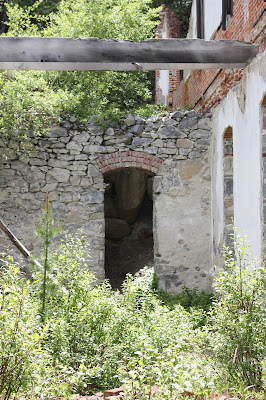
(Photos of Granite, Montana, silver mining ghost town at 7,000 feet high in the mountains. Boom days 1890s)


Sunday, April 26, 2015

YouTube "We Are the Warriors" What are the Odds? Or How to make lemonade out of lemons...


Two or three years ago after visiting with a literary agent about the then-title of my novel, "Powder River Warriors," I was encouraged to change the name. She was hung about about it being about warriors on a river...Nope. So I came up with a new title, did the Google Search thing and couldn't find any other books named "We Are the Warriors" nor any other definite issues with the name regarding the search engines.

In the midst of publishing my novel this past year, I began to see this "Imagine Dragons" thing come up when I searched "We Are the Warriors." Huh?

This last month I did another search...with the title of my novel. Only one reference to one of my blog posts appeared on the first page of results. No book. Instead page after page of a YouTube video by "Imagine Dragons" popped up.  I clicked on the video. Sure enough, a music video about gamers with the verse repeated again and again, "We are the warriors..." Nicely done, graphic art and catchy tune. But 27 MILLION hits! Oh, maybe my clicking on it turned it to over to 28 million hits!

What are the odds? The same year I published my novel?? So can I make lemonade out of lemons?

On a different note, I wrapped up my second Goodreads Giveaway. Thanks to all who participated. The three winners of my signed novels were from Indonesia, Belgium and Michigan (almost a foreign country):).

I have appreciated those who have posted reviews for me. I'm shooting to get a few more up on Amazon and Goodreads. Thanks for all your support and encouragement.

I am stirring the pot with two more books in the works. A long process and somewhat intimidating. A few more snow storms and it might almost be spring in Montana...


Friday, March 27, 2015

Goodreads Giveaway and Award


Congratulations to the winners of my Goodreads Giveaway that wrapped up on March 25th! The total number of people entering the giveaway was 829. Five people won copies of "We Are the Warriors." Of these five, three were from Canada and two were from the United States (Florida and New York). Thank you to all who entered the Giveaway. 

The day after I mailed out my novel to the winners, I was notified that I had been selected as a Finalist for the USA Regional Excellence Book Awards for the Young Adult Fiction category, West region. I was so excited to hear the news! I knew the USA REBA awards would be announced in mid-March and was waiting to hear, without "expecting" too much. 

The announcement stated "Your book, We Are the Warriors, truly captured the spirit of the West region of the United States and the excellence that this award was created to celebrate, and we salute you and your fine work."

Only one Winner is named for each category of the USA REBA awards. Finalists are not necessarily awarded for each category. So many categories did not have Finalists awarded. Judges also reserved the right to not make an award in a category. 

The REBA awards sites states, "often there is more than one book in a category that truly stands out, and we believe these deserve recognition also. While it makes the job of our judges harder in some ways, we are dedicated to celebrating excellence in self-published books. So we created the category of "Finalist." Books that are recognized as Finalists are in every way outstanding. The difference between the Winner and Finalist books are often so minute that the call might have gone either way." 

The West region that my novel was named a Finalist for includes the states of California, Alaska, Colorado, Hawaii, Idaho, Montana, Nevada, Utah, Oregon, Washington and Wyoming.

After all the years of work and taking the leap of indie publishing, the recognition is muchly appreciated.

Wishing you in the northern hemisphere a wonderful start to spring and ALL a good Easter week.


Sunday, February 1, 2015

Blizzards and Editing


I have found both format editing and blizzards painful while in their midst, but each also results in wonderful connections and beautiful art.

The last true blizzard I was in, I was fortunate to be near our house in Wolf Point. As I drove the short mile from work with my husband, Jerry, only fifty yards behind me in the Acadia, the cross streets disappeared as sheets of snow beat in waves from the northwest. A white and gray pall covered the landscape and sky, obscuring any distinct shapes and forms. I diligently plowed my way up the 4th Avenue hill.

I feared I wouldn't recognize the way home. A similar fear and trepidation sometimes comes over me when I sit down to edit a long literary piece. I don't know my way through the mass of words and punctuation. I fear making a mistake and causing more problems and errors.

In a state of confusion that day, I gripped the steering wheel, and peered out into the haze. The outline of the towering cottonwoods at the corner of our turn finally broke through the dense whiteness, their bare branches rattling in the wind like angry giants.

My Impala bravely bucked through the drifts forming across the city streets. I stared out the windshield, and nervously hoped no one was hidden in the blinding snow. My foot on the gas pedal, I dared not slow down, knowing one of those drifts would grab my wheels and not let me out.

In the process of editing, when I hit "find" and "replace" in a document, especially when it has resulted in 1,000 cases "found," a tremor of dread runs through me before I hit replace. What if I make it worse and get stuck? What if I ruin the whole novel?

That afternoon as I approached an unsheltered curve in the road, less than a half of a block from our house, the shadowy form of a van, obviously tightly stuck in a drift, came into view. I let up on the gas and steered to the side to avoid hitting the vehicle. First mistake. With a sudden "fump!" my car came to a halt. The right side of the car sat higher on the wind-packed drift, as my wheels spun.

My husband stopped a hundred yards behind, got out and fought his way to my car. As I opened the door, a rush of snow blew in, covering the floorboards in a fine layer. He suggested I back his Acadia up to the next side road to open up the center of the street while he tried to get my car unstuck. I clambered into his vehicle and backed into the side road, firmly hitting another two foot drift. Second mistake—beware of side roads. I tried to go forward or backward, to no avail. Now the Acadia was unable to move.

Sometimes I do get stuck and bogged down when I am editing. The time I fought with fixing my "smart" quote marks and "straight" quote marks, I couldn't figure my way out. I finally got it done, probably not the easiest way.

Jerry and I trudged to our house, only seventy-five yards in distance. The wind chill was an unbelievable fifty degrees below zero or more. We changed from our office clothes into jeans and down parkas, gathered more shovels, and headed back into the onslaught.

Frantically we pulled shovel-fulls of snow from under the car. Each time we pulled out a chunk of snow, new snow replaced what we had just removed. Every time we opened the car door to attempt to rock the car free, the white powder filled the compartment like piles of flour. Whenever we opened our mouths to speak, the wind-driven snow blasted our throats like pieces of sand and knocked our breath back down our throats, resulting in gasps of air. The snow melted on our faces and then refroze wherever it could. My eyelashes were thickly caked, heavy with ice that threatened to freeze my eyes shut. The whole endeavor seemed hopeless. I felt like we should just quit, but we couldn't leave our vehicle blocking the road.

Through the blinding snow, a huge four-wheel drive pick-up from the Fort Peck Tribal Police crawled its way toward us. A big, burly tribal cop climbed out, snow nearly up to his hips. He grabbed one of the shovels and got to work on the dense drifts under my car. A tribal high school student clambered out of the truck, wearing what looked like a spring jacket. They both shoveled, pushed and pulled alongside of us. It seemed like an impossible task, but the guys never quit, never expressed any doubt or dismay. Finally, with one more big effort of all hands pushing, my car broke free. Relieved, I promptly drove it into my driveway and parked it.

Then we went to work on the van and our Acadia. By then glasses were useless, only reservoirs for ice and snow. Hands worked clumsily, the painful cold beginning to numb. With tireless effort, the cop, his young friend and other neighbors chipped in to fight against the relentless wind and snow.

There is nothing like friends, books, experts, co-travelers posting up on Google, to assist with the process of learning to edit more skillfully, I have had very good input, knowledge and suggestions over the years. I marvel at how little I knew about writing—that is, the whole process—seven years ago! Eventually with much effort and help, I/you will make our way through an edit, a process, a piece of art or a new woodworking project.

Finally, our vehicle and the van broke free. Trudging up the driveway late that day, exhausted, frigidly cold, I spiked our shovel into the snow bank at the corner of our house, an offering for the next stuck vehicle. Jerry, by then nearly hypothermic and shaking uncontrollably, fell into a hot tub of water.

How many people and cars that policeman and his friend freed from drifts that day, I don't know. But I admired their courage, tenacity, and willingness to take on such a daunting task—cheerfully and optimistically.

The results that day—freed vehicles, grateful people safe at home—and eventually, artfully created drifts, and moisture for the land to irrigate and grow summer crops and pastures.

Format editing long documents like a novel or a thesis can feel a bit like facing the relentless onslaught of a blizzard. But bit by bit, sentence by sentence, with persistence and some help, a structurally sound and beautiful document can be created.


Happy editing, formatting and digging out of snow drifts if that is what is needed. The outcome may be awesome. Spring will come.


Thursday, December 11, 2014

Pain and Prejudice


We Are the Warriors, a novel set on a fictitious Indian reservation, is almost ready to go public. My editors and proof readers have provided insights and suggestions, the cover is almost completed, and Blake's story about life in Powder River is about to unfold, first as an ebook the end of December, and in paperback after the first of the year.

We Are the Warriors’ main character, Blake, is a seventeen year-old—a white kid and avid snowboarder— who is thrust into the middle of a plains Indian reservation. Blake's story is a story of his fears, his search for friendship, and his gradual understanding of those different from himself. It is a journey through his own experiences and changing perspectives.

Living for thirty years on the Fort Peck Assiniboine and Sioux Reservation, the images and persona of "warrior" for me have been multifaceted. One of my early introductions to the cultural life of Wolf Point was attending the Wild Horse Stampede, a rodeo well respected by the cowboys and cowgirls across the West.

My first trip to the Stampede, sitting in packed stands as the blue smoke-haze rolled by and beer amply flowed, I encountered an event that surprised and shocked me. It began with an auctioneer leading the bidding, the Calcutta, for the wild horse teams while standing in the back of a pick-up in the dirt arena. As the auctioneer's voice spun by, like a train on a track, the bids went up by hundreds of dollars, some even reaching over a thousand. The Jackson name brought the bids in higher and higher. Later I learned the Jackson "boys," men from the small tribal town of Frazer down the road, were highly respected for their ability as wild horse racers.

The Wild Horse Race that occurred after the next event was the most insane, wildly dangerous event I had ever witnessed. About eight unbroken broncs were pinned in chutes, while three men, on the inside of the arena, stood in front of each horse. Two men grasped a lead rope attached to the bronc, typically very large and strong guys, and the third held a loose saddle, usually a smaller, light-weight man.

At a signal, all eight horses are released into the arena as the gates fly open and twenty-four men attempt to subdue the wild blood and muscle before them. Hooves fly everywhere, men are tossed in the air, horses run into one another. It is not a matter of if someone will get hurt, just how badly. Some teams manage to get a saddle on their horse. The rider, clinging on however he is able, attempts to ride the horse to the other side of the arena.


By now, half the horses have broken away from their supposed masters and run wildly around the arena, their ropes dragging behind them. The few horses that are saddled up with a rider, buck or run randomly. If a rider is lucky or skilled enough to get to the other side, past the white chalk circle, he pops off the cinch on the saddle midstride, flies through the air, hoping to land without damage, then hauls the saddle back to the chutes.

The pandemonium in the middle of this race is hard to describe. The sheer magnitude of possible injury unbelievable. It reminds me of the Running of the Bulls, but ten times more unpredictable. I was shocked by the crowd's enthusiasm and enjoyment of the event—like those waiting for a NASCAR crash or watching those high-risk-taking videos. Many of the teams were tribal, although not all. The most skilled and admired apparently were the tribal teams. Rodeo is a dangerous enough event. Cowboys take on one horse, one bull at a time and usually can see what is coming at them. This was by far more hazardous.

As the years went by, I would at times walk out to the concession stands during the Wild Horse Race to protest what I saw as a macabre, violent fascination. I did not want to be part of seeing others beat up, hurt and possibly killed. At other times I would sit there with the rest of the crowd, relieved when it was over. One year a young tribal man, saddled up, sliding sideways off a horse galloping around the arena at about thirty miles an hour approached, from the opposite direction, a pack of wild horses, running equally fast, their ropes dragging on the ground. The man, hanging sideways, his head at the level of the horse's chest, met the chest of one of the horses charging the opposite direction. Not good.

I'm not sure how long he was in regional medical centers dealing with his head injury. A couple of years later I crowded into a spot in the stands as the Calcutta for the teams began. Huh, what? His name was read as a member of one of the wild horse teams! I don't get it. He's going out there again!


Later, that next summer my husband and I went to the Red Bottom Pow-wow. We wandered towards one of the benches, hoping to blend in. Fat chance. But we did see a few familiar faces.

A young man, dressed for the grand entry, came up to us and welcomed us to the pow-wow. He reminded us of who he was, a fellow student of our older son, now in his thirties. As he spoke I began to recognize the face and build from years ago. I could again picture him as the athletic, point guard he was years ago for the Wolf Point High basketball team. As he walked away, feathers swishing and metal jingling, I felt happily surprised to be so welcomed by the young man.
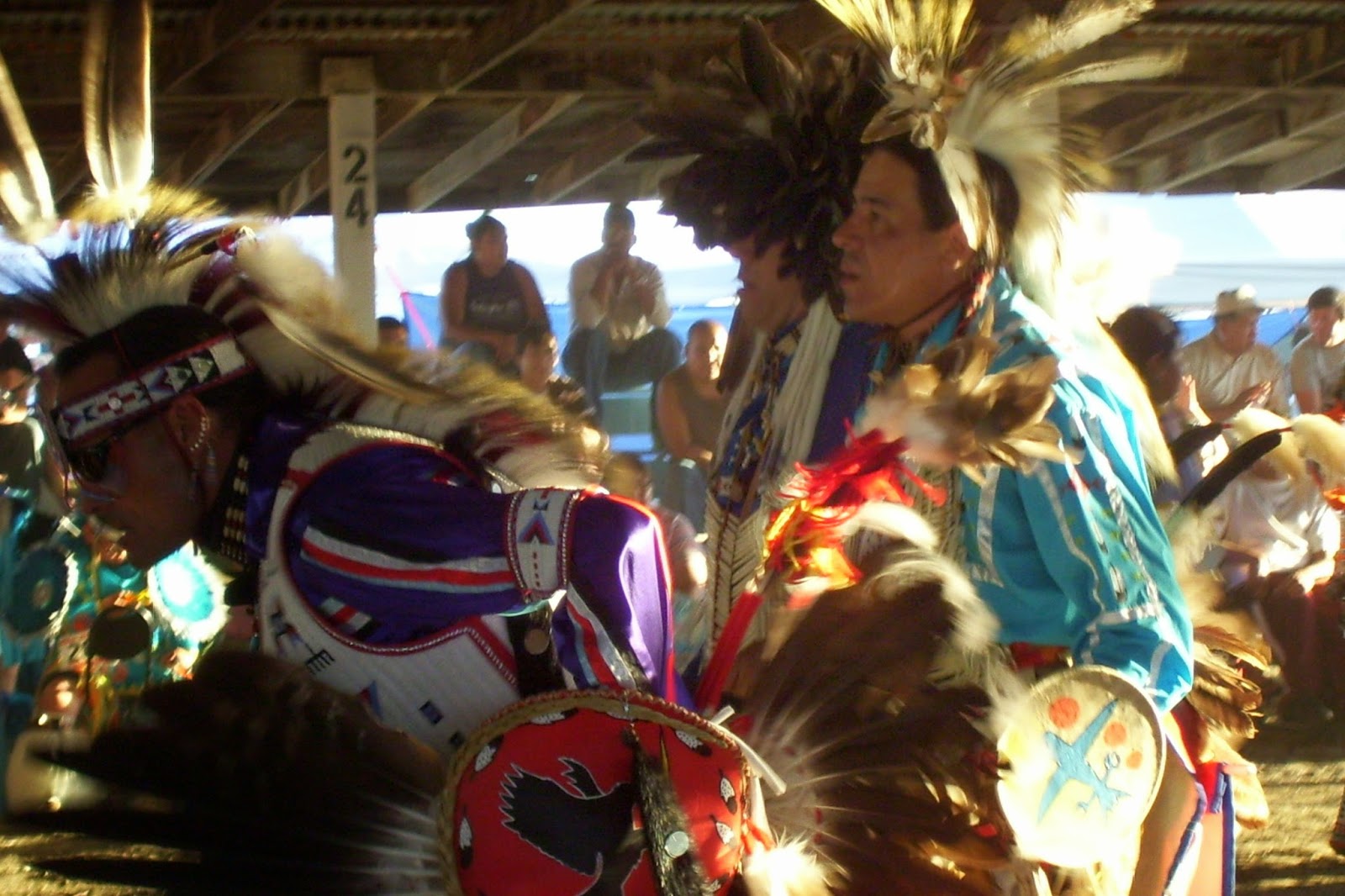


As the grand entry got underway, the tribal members with military service were asked to lead the entry. The drums and voices surrounding them in respect. The warrior as always, is highly regarded in tribal circles. Next, to my amazement, the caller announced the honoring of the wild horse racers, with their entrance into the arena. These men, who tackled horses in a wild, free-for-all, are highly regarded by the Assiniboine Red Bottom Clan. I couldn't believe it. My mind had to make a cultural U-turn to see the Wild Horse Race from another viewpoint, one foreign to me. Obviously there was something powerful being said here. The ancient, and yet still current role of warrior emerged as vital to tribal life. I still ponder and process this perspective, one that challenges my way of seeing, of admiring participants of a wild, dangerous, even deathly event.

I still cringe when I hear that one of my son's classmates has chosen to be on a wild horse team for the Stampede and will to participate in this unpredictable, uncontrolled and dangerous event. I wonder how his parents or family members feel about it. I pray they stay safe.

My novel, We Are the Warriors is fiction. The amazing thing about fiction is that it can often tell an even more powerful story than true life, because with fiction there are no specific apologies needed and no permissions required to share the whole story. A fictional account speaks for itself and its characters have a life of their own.

Even before I moved to Wolf Point I had often reflected on my family ties to Native Americans. I knew my dad had graduated from St. Labre Indian School. I grew up visiting my grandmother in Lodge Grass on the Crow Reservation. I was also aware there were some family members with darker skin and hair. I wondered if I had American Indian ancestry. For years I searched, asked questions of older family members, checked family lines, but never did find a connection to American Indian ancestry. Even as a young kid I knew that "white folk" would hide that kind of information—and I knew that was wrong.

Will I ever see life exactly as a Native American, First Nations or indigenous person who grew up and lived on an Indian reservation? No, I can't. But I can listen to my stories and the stories of those around me. I can process and see as one of European ancestry, white and female, who grew up on the banks of the Yellowstone River and  lived for most of her adult life on a reservation—a place of unique experiences, a place of complexities and conundrums. My experiences on "the rez," those of the warmth of family care and concern, the shock and tears of sudden death, the gut-wrenching results of teenage decisions, and the comradery of working together for common goals, are all a part of me.


I present Blake's story as one individual's story, from his limited and changing perspective. We all have a story to tell—uniquely ours, unrepeatable, worth telling and ever changing.
Wednesday, November 19, 2014

Almost Over the Edge


Am I being dragged, sucked and propelled toward the edge of a thundering waterfall? This past April, after years of writers' conferences, meetings with agents, query letters, and buying, begging or borrowing writing books from which to study, reflect on, and hone my skills, I decided to self-publish. To go from the excitement of having a literary agent ask for my manuscript, then making major changes, to never hearing from them again, was probably the proverbial "last straw" or possibly "the last entire log"...(Yes, I did use a clique′.)

As far as my writing goes, you know how it is—one day I feel like my writing is magnificent, the next day I feel the same writing is a pile of shit. My son once aptly told me, "Some people will like your book and others won't. You can't appeal to everyone."

With some kindly recommendations, I found a professional editor this spring. Honestly, I didn't expect to work so hard after years of editing my young adult novel...His eye for detail was astounding! I received my second edit this past month. Now onward with the self-publishing journey.

No matter how high the bar feels like it has gone, it still goes higher. Reformatting my novel for Smashwords so it can also be distributed to Barnes and Noble, Apple and Sony has been a challenge. Next task is reformatting for Kindle. I think my brain is going to split with analyzing it all.

Of course, I am required to have a cover for my ebook or novel before publishing through most outlets. Thankfully, I have found expert help to design my cover.

Turning my novel into a tangible paperback is another hurdle. I'm slowly working my way that direction. It is all a bit intimidating. I want to do it well, as good as possible. There is so much to keep track of as I work toward self-publishing, a steep learning curve.

This all said, I haven't even begun to touch the awesome task of marketing in our age of technology and social media. Meanwhile, I hope there are still young people who enjoy reading.

The question I ask as I rush headlong is, "Will I become one with the water as it sparkles, glitters and bounces playfully over the precipice, each tiny droplet set free? Or will the encounter be something else? Not nearly so pleasant, but still an adventure?


Wednesday, October 22, 2014

Bright Blooms in Winter


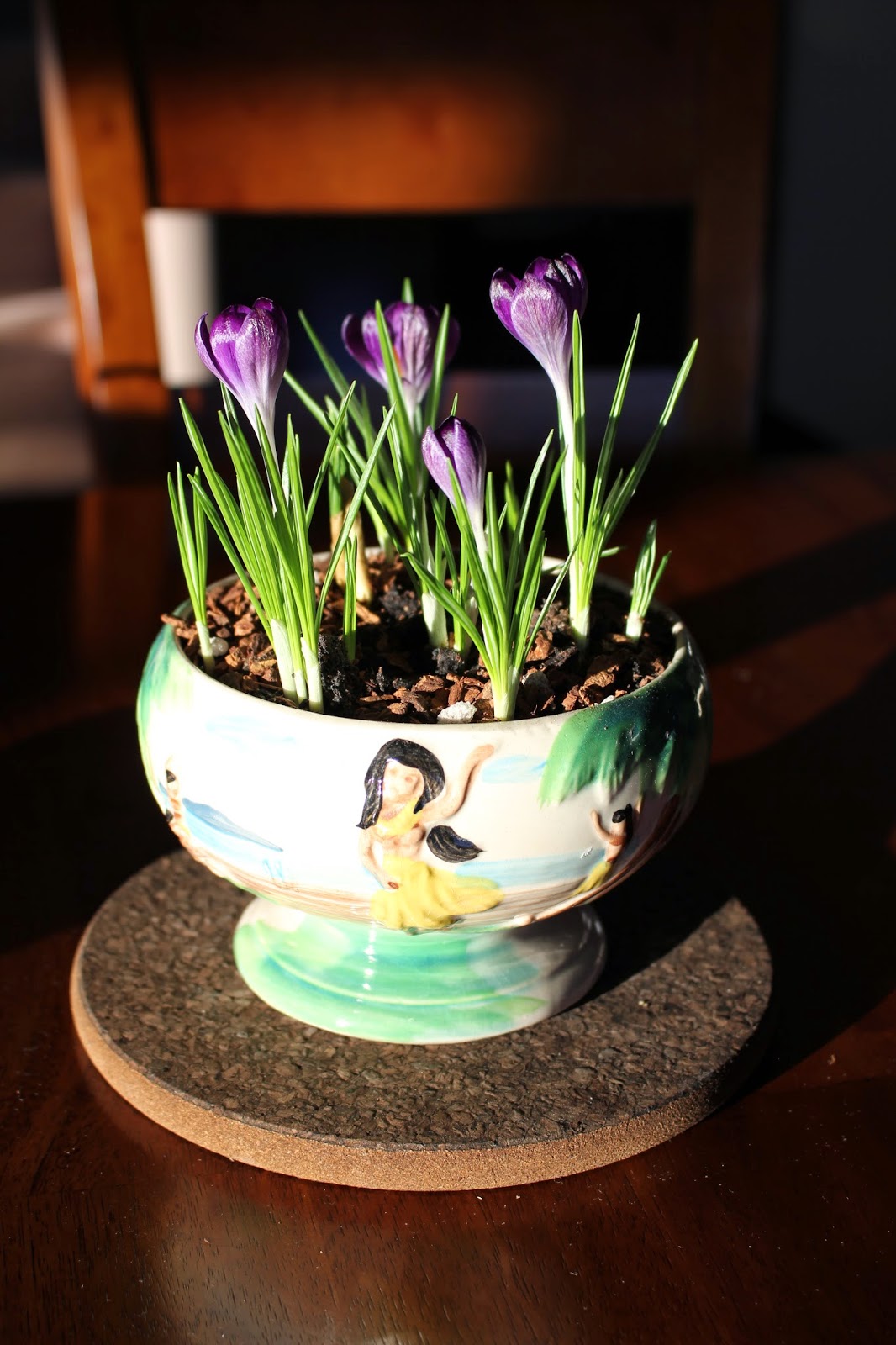
The time has arrived. Pot up your bulbs and enjoy the beauty of indoor flowers during the frigid months of January and February.

All you need is a bit of garage space that goes down to at least 40 degrees for several months, a few old pots, potting soil, and some early season spring bulbs, and you are good to go.

Following is a step-by-step introduction to growing or "forcing" your own bulbs to bloom in the winter. It is a delightfully fun and mystifying project.


1.  Select some early-season "hardy" bulbs such as crocus, tulip, narcissus (daffodil) or hyacinth. Early-season instead of mid-season or late-season bulbs have a better chance of blooming with the forcing method. Hyacinths are beautiful, but for me, the long bloom time seemed to put a lot of perfume and pollen into the house. So now I usually plant crocuses, tulips and daffodils.


2.  Old interesting pots discovered in the shed, at garage sales or at second hand stores can add a spark to your planting. It helps if the pots have drainage holes, but if you find some you like without holes, just add gravel to the bottom or be very careful not to over water. I also use a lot of the old thin plastic pots that bedding plants come in and then when I am ready to bring the bulbs in the house, I slip them into a nicer looking flower pot. You can use small pots, except for the daffodils bulbs which are usually quite large and will need more space and depth.

3.  Select some potting soil. If you can find some heat-treated soil it minimizes the chance of having knats or other insects hatch out from the soil when it is brought into the warm house. Unfortunately most name-brand potting soil is not heat-treated. Some greenhouses carry shredded coconut potting soil which is finer, has fewer large sticks and usually has less insect problems.

4.  If you can find a few old large plastic buckets or bins these are helpful to put the potted bulbs in while they are chilling in the garage. The bins keep rodents away from the bulbs and the few times you water the bulbs they will keep water from running over your garage floor.


5.  Now to get started potting up the bulbs...I usually try to find a warm fall day I can work outside in the driveway and not worry about the mess. Sometimes I settle for a cool day. Don't worry about the directions for depth and spacing of the bulbs. When you force bulbs, you get to break all the rules. Usually forced bulbs are only good for one season, but sometimes I've dumped the old bulbs in garden spaces and they have bloomed in a year or two.


6.  Fill your pots half full of damp potting soil. Arrange your bulbs, tips up. Crocuses will end up one inch below the soil height, and tulips, daffodils and hyacinths tips will barely be under the soil or only slightly sticking up. I usually place the same type of bulbs in one pot due to the varieties of bloom times, but sometimes it is fun to mix them up and see what happens. Fill in damp soil nearly to the top of the pots, leaving a half inch below the rim to hold the water when you need to dampen the soil. If the soil isn't too wet, you may water the bulbs in. Just be careful not to over water, especially if you use pots without drainage holes.


7.  Stack the pots in your large plastic buckets or bins, cover them with newspaper and place in a cool, dark place. I usually put mine in the garage. If you are in very cold northern climates, place them against the interior, back wall of the garage to minimize extreme freezing.


8. Now you wait—creatively, doing other fun things, of course. Forcing bulbs works best with a dark, cold period where the temperature is at least as cold as 35-48 degrees. My bulbs have often been in unheated garages when the outside temperature was often 25 below zero or colder. They did fine. This dark, cold period is usually followed by a shorter cool, light period of optimally 55 degrees. At one time I had an unheated room in our house that was perfect for the cool period. But now I just place the pots in the coolest place in the house, out of direct sunlight for the few weeks of cool temps.


9.  Recommended cold periods are 10-12 weeks for crocuses, and 12-15 weeks for most other bulbs. Cool, light periods are 2-4 weeks to encourage gradual root growth and blooming. So if I plant in October, I can bring the pots into the house in January. I usually bring in several pots every couple of weeks to extend the bloom time for a couple of months. If you stack your pots in the garage you may have to keep an eye on them as temperatures warm so they don't sprout crooked under the weight of the other pots.


10.  Water your pots only lightly in the winter. Most winters I only water the bulbs twice. You only want them damp, not soaking wet. Drier is better.

Then enjoy—flowers in January and February—what fun!


For more information see Forcing, etc. by Katherine Whiteside, Workman Publishing, New York or your favorite gardening website.